

Hey there! As a supplier of PBAT and PLA, I often get asked about the mechanical strength of these materials. So, I thought I'd dive into it and share some insights with you all.
First off, let's talk a bit about what PBAT and PLA are. PBAT, or Polybutylene Adipate Terephthalate, and PLA, or Polylactic Acid, are both types of biodegradable polymers. They're gaining a lot of popularity these days, especially in the packaging industry, because they offer an eco - friendly alternative to traditional plastics. You can learn more about Biodegradable Resin on our website.
Mechanical Strength of PLA
Let's start with PLA. PLA is derived from renewable resources like corn starch or sugarcane. It's pretty rigid and has good tensile strength. Tensile strength is basically how much a material can be stretched before it breaks. For PLA, the tensile strength typically ranges from about 40 to 70 MPa (megapascals). That's not too shabby! It means that PLA can hold up well under a certain amount of pulling force.
However, PLA has its drawbacks when it comes to mechanical properties. It's quite brittle. This brittleness makes it prone to cracking or breaking when it's bent or subjected to sudden impacts. For example, if you were to make a thin PLA film and try to fold it sharply, it might just crack right away.
Another aspect of mechanical strength is flexibility. PLA isn't very flexible compared to some other polymers. Its low flexibility limits its use in applications where a material needs to bend or stretch a lot. But don't get me wrong, there are still plenty of uses for PLA. It's great for things like 3D printing filaments, disposable cutlery, and rigid packaging. You can find out more about PLA Material on our site.
Mechanical Strength of PBAT
Now, let's move on to PBAT. PBAT is a copolymer, which means it's made up of two different types of monomers. This unique structure gives PBAT some really interesting mechanical properties.
PBAT is known for its excellent flexibility and elongation at break. Elongation at break is the percentage increase in length of a material before it breaks when it's being stretched. PBAT can have an elongation at break of up to 700% or even more. That's incredibly high! It means that PBAT can be stretched a whole lot without breaking.
In terms of tensile strength, PBAT is usually in the range of 10 - 30 MPa. While this is lower than PLA's tensile strength, the high flexibility more than makes up for it in many applications. PBAT is often used in applications where a material needs to be soft and stretchy, like in shopping bags, agricultural films, and food packaging. You can check out our PBAT PLA products page for more details.
Combining PBAT and PLA
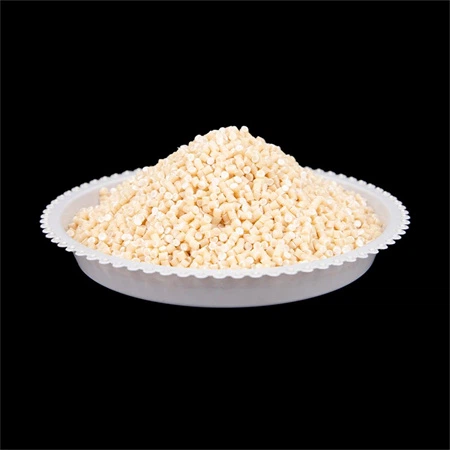
One of the really cool things we can do is combine PBAT and PLA. By blending these two materials, we can create a new material that has the best of both worlds.
When we blend PBAT and PLA, we can improve the brittleness of PLA. The flexible PBAT acts as a sort of shock absorber, reducing the likelihood of the blend cracking or breaking under stress. At the same time, the relatively high tensile strength of PLA can help to increase the overall strength of the blend compared to pure PBAT.
The ratio of PBAT to PLA in the blend can be adjusted depending on the specific mechanical properties we want to achieve. For example, if we want a material with high flexibility and a bit of strength, we might use a higher proportion of PBAT. On the other hand, if we need more rigidity and can tolerate a bit less flexibility, we can increase the amount of PLA in the blend.

Factors Affecting Mechanical Strength
There are several factors that can affect the mechanical strength of PBAT and PLA. One of the main factors is the processing conditions. The temperature, pressure, and speed at which these materials are processed can have a big impact on their mechanical properties. For example, if the processing temperature is too high, it can cause degradation of the polymers, which will reduce their strength.
The molecular weight of the polymers also plays a role. Higher molecular weight polymers generally have better mechanical properties. They can form stronger intermolecular bonds, which leads to higher tensile strength and better overall performance.
Additives can also be used to modify the mechanical strength of PBAT and PLA. For example, plasticizers can be added to increase the flexibility of PLA, while fillers like talc or calcium carbonate can be used to increase the stiffness of PBAT.
Applications Based on Mechanical Strength
The mechanical strength of PBAT and PLA determines their suitability for different applications. As I mentioned earlier, PLA's rigidity and relatively high tensile strength make it a good choice for rigid packaging and 3D printing. On the other hand, PBAT's flexibility and high elongation at break make it ideal for soft packaging and films.
The PBAT - PLA blends can be used in a wide range of applications. They're great for making compostable shopping bags, which need to be strong enough to hold groceries but also flexible enough to fold and carry. They're also used in agricultural mulch films, where the material needs to withstand outdoor conditions and some mechanical stress.
Why Choose Our PBAT and PLA?
As a supplier, we take pride in providing high - quality PBAT and PLA products. We carefully control the production process to ensure that our materials have consistent mechanical properties. Whether you need a rigid PLA for your 3D printing project or a flexible PBAT for your packaging needs, we've got you covered.
We also offer custom blending services. If you have specific mechanical requirements for your application, we can work with you to create the perfect PBAT - PLA blend. Our team of experts is always ready to provide technical support and advice to help you make the best use of our products.
Contact Us for Procurement
If you're interested in purchasing PBAT or PLA, or if you want to learn more about our custom blending services, don't hesitate to get in touch. We're here to answer all your questions and help you find the right solution for your business. Whether you're a small startup or a large corporation, we can provide the materials you need at a competitive price.
References
- "Biodegradable Polymers: Principles and Applications" by Andrew L. Andrady
- "Handbook of Biodegradable Polymers" edited by Abhijit S. Datta and Anil K. Bhowmick
So, that's a pretty in - depth look at the mechanical strength of PBAT and PLA. I hope this blog has been helpful to you. If you have any more questions, feel free to leave a comment or reach out to us.